
OOPSLA 2026
Interactive Data Analysis
with Lively Typed Tables
Alexander Bandukwala · Cyrus Omar
University of Michigan's Future of Programming Lab
Exploratory data analysis today
Exploring, cleaning and reshaping data in a live programming environment: writing code and running it are interleaved.
but that feedback is
- mostly autocomplete and
suggestions
few diagnostics or error marks on the code - based on the current runtime
state
from the values the kernel holds, not the code - only there for global
variables
limited support inside of functions - dependent on cell execution
order
cells run or edited out of order give non-reproducible feedback for analyses†
† Out-of-order execution in notebooks: Pimentel et al., MSR 2019 · Chattopadhyay et al., CHI 2020
Types for table schemas
| date | element | value |
|---|---|---|
| "2010-01-30" | "tmax" | 27.8 |
| "2010-01-30" | "tmin" | 14.5 |
| "2010-02-02" | "tmax" | 27.3 |
| "2010-02-02" | "tmin" | 14.4 |
| date | tmax | tmin |
|---|---|---|
| "2010-01-30" | 27.8 | 14.5 |
| "2010-02-02" | 27.3 | 14.4 |
wide have?The column values are being promoted to the schema.
"tmean" be rejected statically?Fancy type systems
One answer is to make the type system richer
Type system features
- Record operations, row polymorphism Cardelli & Mitchell 1991 · Wand 1987 · Rémy 1994
- Heterogeneous lists, dependent records Kiselyov et al. 2004 · Waszczuk et al. 2017
- Match types, named tuples Blanvillain et al. 2022 · Odersky 2024
Applied to tables
- Dependently typed tables Lean: Rotella 2024 · Idris: Wright et al. 2022
- Typed Spark datasets Scala: Frameless (Typelevel)
These are powerful: they can type the operations tables need.
But value-dependent operations need a full scan of the dataset.
And in exploratory analysis, you don't yet know what's in that data.
Our approach
- Use static typing when convenient
- Fall back to gradual typing when our static types are not enough buys expressivity · costs feedback
- Introduce live typing provides the feedback static types cannot
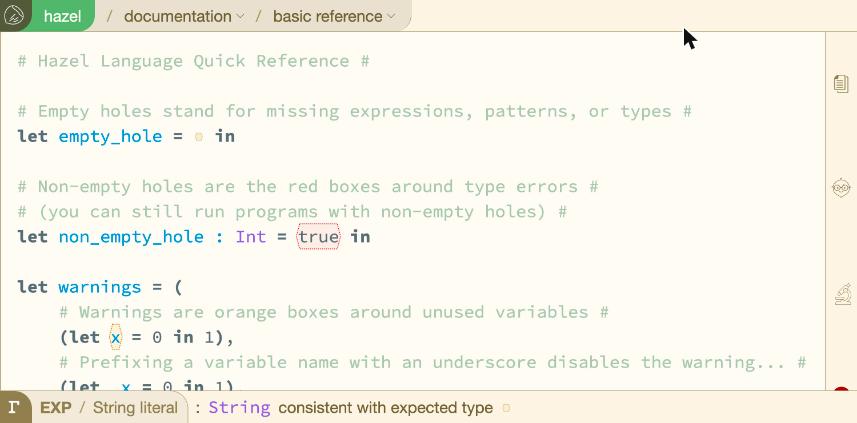

We build on Hazel, a live and gradually typed programming environment.
Hazel Lab Hazel + structural operations + live typing + rich probes
Tables as lists of labeled tuples
Brown Benchmark for Table Types
B2T2 Lu, Greenman & Krishnamurthi 2022
Example tables, programs and error scenarios — and a Table API of 49 operations.
Can our type system express the operation?
Can it enforce its constraints?
one operation from the Table API
nrows(t2) = nrows(t1)
B2T2: Hazel
| operations expressible | preconditions enforced | postconditions enforced | |
|---|---|---|---|
| Hazel | 17 / 49 | 4 / 72 | 29 / 142 |
- Labels are not first classA label cannot be passed to a function, returned from one, or computed.
- No polymorphism over schemasNo static type that accepts tables with different schemas.
one operation from the Table API
Labeled tuple to list conversions
to_lvs: tuple to listEach entry becomes a label–value pair, the label a string.from_lvs: list to tupleBuilds a tuple back from label–value pairs.
to_lvsreturns[(label=String, value=τ)]
τ is the meet of the entry typesfrom_lvsreturns ?Labels are determined at runtime
B2T2: Hazel Lab
| operations expressible of 49 |
preconditions enforced of 72 |
postconditions enforced of 142 |
|
|---|---|---|---|
| Hazel | 17 | 4 | 29 |
| Hazel Lab | 49* | 5 | 38 |
Every operation is at least partially expressible, but most constraints go unchecked.
The paper also reports an intermediate ablation, Hazel with tuple extension.
* four only partially expressible, e.g.
leftJoin requires the right table to have at least one row
Live typing
In a live programming environment, we have dynamic values. We should use them to bolster static types.
- Observe the values that reach each statically underspecified expression
- Synthesize the type of each observed value
- Combine those types with their meet falling back to the static type if they conflict
- Re-check the program with the unknowns filled in
Statically, this program has no errors
? is consistent with every type, so static analysis has nothing to report.
let sum : [Int] -> Int = ... in
let to_string(d : (String, ?)) =
    case d                                           (String, ?)
    | ("int",  v) => string_of_int(v)                Int
    | ("bool", v) => string_of_int(v)                Bool
    | ("nums", v) => string_of_int(sum(v))           [Float]
    | (_,      v) => "Unknown: " ++ v                ?
    end
in
to_string("int", 1);
to_string("string", "hello");
to_string("bool", true);
to_string("nums", [1., 2.]);
map([("string", "world"), ("bool", false), ("nums", [])], to_string)
Is this just dynamic typing?
The opening example again, with a
report that is never called.
- Checks code that never ran
reportis never called. - Marks in the editorOn the code, not in a stack trace.
let readings = [(id="MX17004", element="tmax", value="27.8"), …] in
let wide =                  [(index=String, tmax=String, tmin=String)]
  pivot_table(readings, …) in
let report() = wide.tmean in
length(wide)
Back to the benchmark
| operations expressible of 49 |
preconditions enforced of 72 |
postconditions enforced of 142 |
||
|---|---|---|---|---|
| without running | after running (live typing) | |||
| Hazel | 17 | 4 | 29 | 29 |
| Hazel Lab | 49* | 5 | 38 | 96† |
No extra annotations, and no richer types in the surface language.
Live typing doesn't help preconditions.
The paper also reports an intermediate ablation, Hazel with tuple extension.
* four only partially expressible, e.g.
leftJoin requires the right table to have at least one row
† assumes each call returns a table with the same schema every time it runs
Rich probes for tables
A domain-specific view of a probed value, where direct manipulation edits the underlying syntax.
User study
An exploratory lab study with users familiar with statically typed functional programming. Not intended to assess transfer to data scientists without training.
- Can users use Hazel Lab's table operations to do basic data transformation and data cleaning tasks?
- Can users effectively use rich probes in data cleaning and transformation tasks? What problems do they face?
- Do users find live typing errors useful in identifying programming errors, and helpful in understanding program behavior?
Study design
- Seven participants, 9 to 30 years of programming
- Two-hour remote sessions
- Hazel tutorial
- Six tasks
- Exit survey
- Within-subjects design
- Matched task pairs, off then on
- Order counterbalanced
Adoption intent questions
Every response at least neutral: 24 of 28 positive, none negative.
All seven were already fluent in statically typed functional programming.
Not intended to assess transfer to data scientists without that training, many of whom work in Python or R.
Related work
live typing
- Type providers Syme et al. 2012A compiler plugin builds types from the data source.
- The Gamma Petricek 2017Lazily generates methods for dot-driven development, one pipeline step at a time.
- RubyDust An et al. 2011Infers static types from test runs, as a batch step before type checking.
- REPLs, Jupyter Pérez & Granger 2007Feedback is driven by the kernel's current state.
- Cuis Smalltalk Wilkinson 2019 · Ostrovsky 2024The VM tags each variable with the set of classes it has held. A checker flags incompatible method calls.
rich probes
- Livelits Omar et al. 2021GUIs that fill a hole with a literal of one fixed type.
- The Gamma Petricek 2017 · 2022The table preview doubles as an editor, with buttons to add or remove steps in the chain of method calls.
- Histogram Petricek 2019Direct manipulation of table previews. The program is a log of interactions, and functions keep their sample inputs.
- Mage Kery et al. 2020A table widget can be summoned on a notebook variable, and its actions are written back into the cell as code.
Future work
live typing
- Stream results into the typechecker as they are produced, so a mark can appear during a long computation
- Integration with fancy types
- User-configurable granularity, instead of on or off for the whole program
- Other treatments of inconsistent observations, which keep their static type today
rich probes
- User-definable and composable rich probes, reconciled with livelits
- Actions for probes on patterns, read-only today
Scalability
- Incremental typechecking and evaluation, for notebook-like responsiveness
- Columnar table representations
- A foreign data interface: data stays in external storage but behaves like a table in the code
- Move computation to the data, such as by compiling Hazel data pipelines to Apache Spark Apache Foundation 2025
- Productionalization: performance engineering to move the research prototype to a real tool
summary
Hazel Lab
- A gradually typed tabular programming system
Conversions between labeled tuples and lists let a
program compute with column names at runtime,
relying on the unknown type when labels can't be determined statically. - Live typing
Values from the running program refine underspecified
types, and the program is re-checked.
Column accesses are checked against names that came from the data, including in functions that never ran. - Rich probes for tables
A probed value can be displayed as a table, with a menu
of actions on each column.
The actions rewrite the source code and leave typed holes when the user has to supply a value.
hazel.org/build/tables-study
Hazel Lab in your browser, start with the tutorial
Artifact on Zenodo: 10.5281/zenodo.21458220

Structural operations on labeled tuples
The same operations on a row whose type is unknown:
let x : ? = (a=1, b=2, 3, c=4)
| example | type | value |
|---|---|---|
(a=1, b=2) ... (b=3, c=4) | ⇒(a=Int, b=Int, c=Int) | (a=1, b=3, c=4) |
project_labels((a=1, b=2, 3, c=4), `a`, `b`) | ⇒(Int, Int) | (1, 2) |
omit_labels((a=1, b=2, 3, c=4), `b`, `c`) | ⇒(a=Int, Int) | (a=1, 3) |
omit_all_labels((a=1, b=2, 3, c=4)) | ⇒(Int, Int, Int, Int) | (1, 2, 3, 4) |
| example | type | value |
|---|---|---|
x ... (b=3, c=4) | ⇒? | (a=1, b=3, 3, c=4) |
project_labels(x, `a`, `b`) | ⇒(?, ?) | (1, 2) |
omit_labels(x, `b`, `c`) | ⇒? | (a=1, 3) |
omit_all_labels(x) | ⇒? | (1, 2, 3, 4) |
These are primitives rather than library functions, because labels are not first-class values in Hazel.
When the argument's type is unknown, so is the result's.
project_labels still knows how many
entries it returns, because the labels are written in the source.
The values are unaffected.
Each result is computed correctly at runtime. Only the static type has lost the information.
Tabular programming systems
| Scala + IDE | Polynote | Jupyter + pandas | Hazel Lab | |
|---|---|---|---|---|
| function barrierno type-directed services inside a function | ● | ◐ | ○ | ● |
| distal feedbackerrors reported far from the cause, and only after running | ◐ | ◐ | ○ | ◐ |
| external schemadata parsed at runtime, so its schema is invisible to static analysis | ◐ | ◐ | ◐ | ● |
| expressivitystructural table operations are hard to type statically | ◐ | ◐ | ◐ | ● |
| out-of-order executionfeedback from execution history rather than from the program | ● | ◐ | ○ | ● |
No existing system addresses all five. Our own row is partial on distal feedback: live typing shortens the spatial distance and not the temporal one — you still wait for the program to finish.
Why the meet?
- Hazel is a static-first gradually typed language. The unknown type exists mainly to give a type to holes, and there is no typecase operation.
- So we assume programs are converging toward more specific types, and take the greatest lower bound with respect to precision.
- In a system with subtyping, or a dynamic-first language, the join would be the right choice instead.
(Int, ?) ⊓ (?, String)  =  (Int, String)
(Int, ?) ⊔ (?, String)  =  (?, ?)
More precise as you go down. The meet of two observations is the highest type below both.
The unknown type is not any
Hazel
let x : ? = "" in
let y = [x, 1] in …
y : [Int]
The unknown type is a placeholder for something more precise, so it gives way
to the Int beside it.
TypeScript
const x : any = "";
const y = [x, 1];
y : any[]
any is absorbing: it propagates outward and erases
the information its neighbors carried.
How to_lvs is typed
A static error if the argument is not a tuple. Otherwise the value type is the meet of the entry types, falling back to the unknown type when they are inconsistent.
to_lvs((a=1, b=2, c=3))            ⤳ [(label=String, value=Int)]

to_lvs((a=?, b=1, c=?))            ⤳ [(label=String, value=Int)]

to_lvs((a=true, b=1, c=2.0))       ⤳ [(label=String, value=?)]

to_lvs((a=(true,?), b=(?,?), c=(?,1.0)))
                                   ⤳ [(label=String, value=(Bool, Float))]
The last case is the interesting one: the meet is computed pointwise, so partial information from several entries combines into a type more precise than any single entry supplied.
One function, two datasets
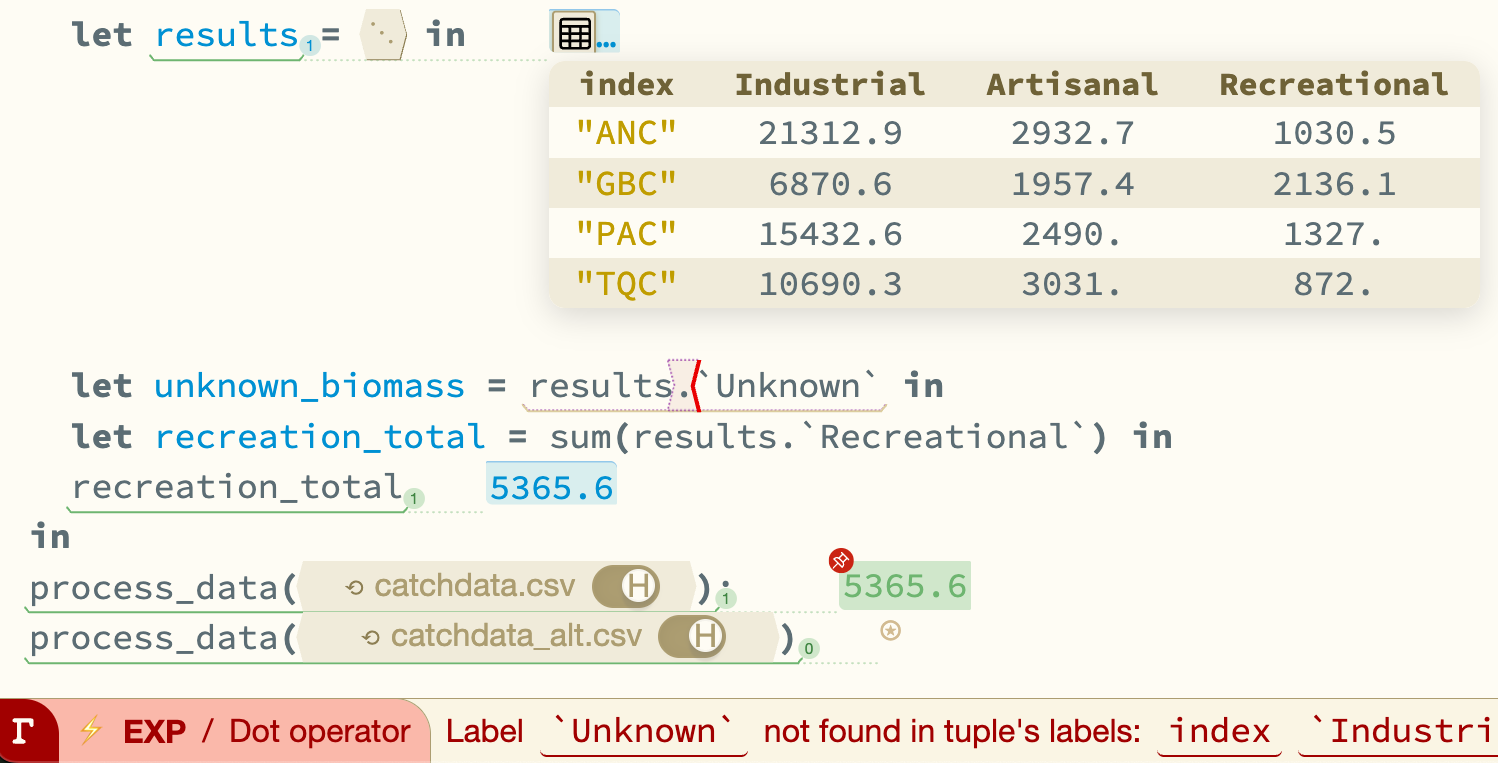
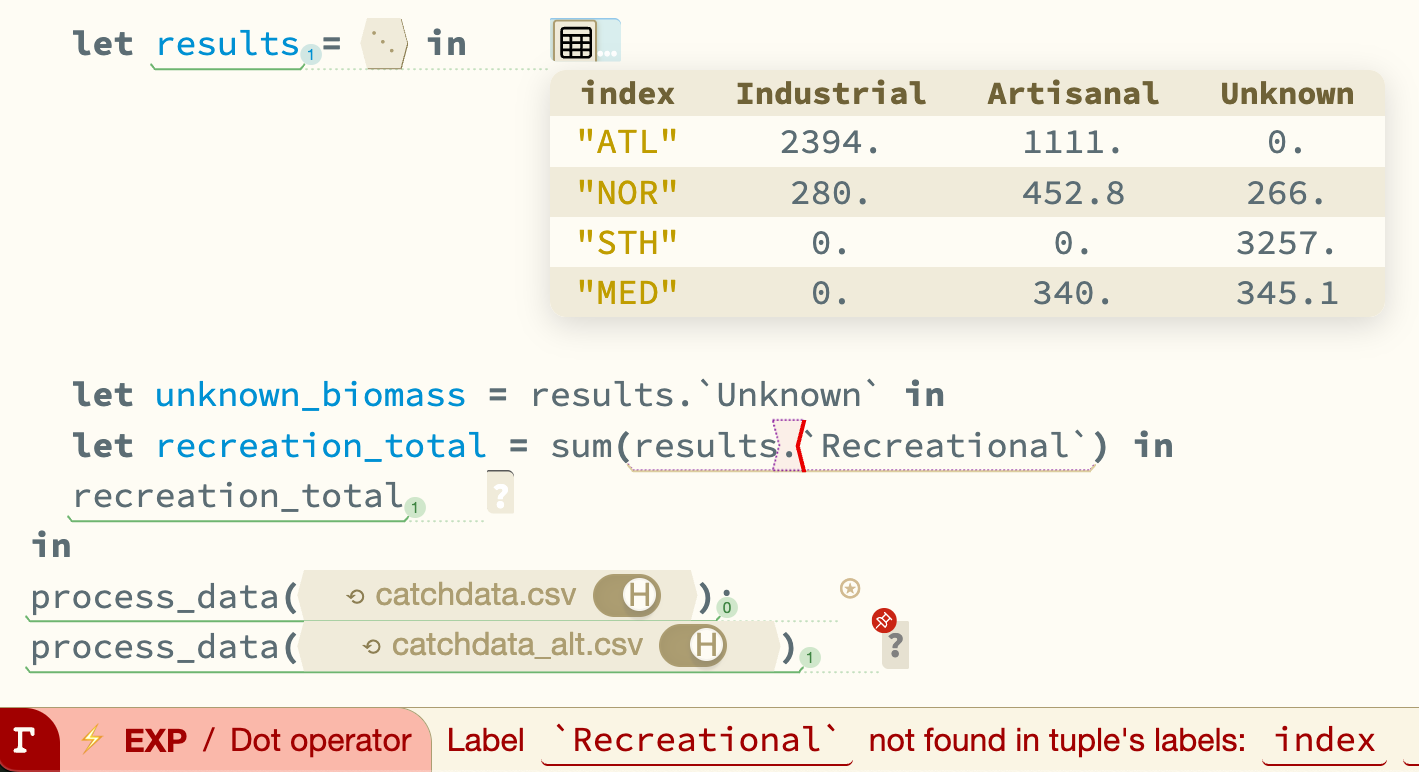
Applied to two datasets, the schemas are inconsistent, so
no meet exists and the result keeps its static type — no marks. Each probe collects one value
per invocation, so pinning one invocation restricts live typing to that call:
the mark lands on Unknown for the first dataset and moves to
Recreational for the second.
What makes this work in Hazel
- Every caller of a function is running in the same environment. The editor is not compiling a library against unknown future callers — it is observing this program, as currently written, with its actual inputs.
- Purity makes the runtime-derived types deterministic and reproducible, and continuous reevaluation keeps them current.
- The cost is dictated by how statically typed the program already is. The more precise your static types, the less there is for live typing to do.
- The flip side: if you were writing a library whose callers are elsewhere, the live types you observe need not match the ones your users would produce.
Column names as data
| name | age | quiz1 | quiz2 | midterm | quiz3 | quiz4 | final | average-quiz |
|---|---|---|---|---|---|---|---|---|
| "Bob" | 12 | 8 | 9 | 77 | 7 | 9 | 87 | 8.25 |
| "Alice" | 17 | 6 | 8 | 88 | 8 | 7 | 85 | 7.25 |
| "Eve" | 13 | 7 | 9 | 84 | 8 | 8 | 77 | 8.00 |
buildColumn(gradebook, "average-quiz", (row) => {
  const quizCols = header(row)
    .filter((c) => startsWith(c, "quiz"));

  const scores = quizCols
    .map((c) => getValue(row, c) as number);

  return sum(scores) / length(scores);
});
Add a column of mean quiz scores. Adapted from B2T2.
gradebook?row?getValue(row, c) return?Statically typing this requires a sophisticated type system.
Live typing on buildColumn
The gradebook example: a new column named by a
string, computed from the columns whose names start with quiz.